|
Rochester Varajet II |
This was not the most popular carb choice that Holden ever made, at least not with many mechanics. Their total non understanding of the correct way to adjust them has unfortunately led to this carby being replaced with Weber's or Holley's. It is fitted to the Camira, Holden 4 star-fire engine and Holden 6 Blue and Black engines as well as a few models from other countries. Two sizes were available in Australia that I am aware of - 28mm primary venturi giving you 375cfm and 30mm primary venturi for 397cfm Common faults with these were:
According to the manufacturer, once the throttle shafts are worn, the base needs to be replaced, however these shafts could be purchased aftermarket in oversize and replaced by an experienced carb re-builder. I am uncertain if these are still available. If this job is not done with the utmost precision with the shafts and discs positioned correctly in the bores, the carb will be unstable at idle. Anti run-on solenoid. (23) Its function is to ensure the engine stops when turned off at the ignition key. On late model vehicles with higher idle speeds this item is required, otherwise the engine may run on for a little bit after switch off. There are two types of anti run-on solenoids.
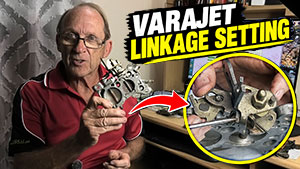
If a very thick compressible base gasket is used under these carbs, DO NOT over tighten the base nuts as this will result in cracking the carby base, but generally a bakerlite plate is used with thin gaskets on either side and if a heat shield is fitted under the carb an extra gasket would be required. The primary & secondary disc position, the idle by-pass adjustment and mixture screw must all be adjusted exactly to manufacturers specs for this carby to perform at its best. Unfortunately in most cases the first thing to get incorrectly adjusted is the primary shaft butterfly position screw which changes the throttle disc position in the bore. This exposes the progression slot which richens the mixture, then the mixture screw is leaned off to compensate and this has a roll on effect on how the carby performs at low speed and drastically affects fuel economy. There are various other linkage adjustments that need to be checked and corrected. Not all are revealed in the GM Varajet manual as they consider these adjustments as not adjustable. If the throttle shafts have lateral movement then have them replaced. All that said though, I can say that this carb when operating correctly will outperform a weber conversion easily, mainly because this carb is a spreadbore and has the best of both worlds, with reasonable economy and good power on the second stage. The big negative is that as far as I know there are no jets or metering rods available for performance tuning. It does however have an adjustable main jet which if still serviceable can be adjusted. From my experience though, it is hard to find a Varajet that still has a main jet screw that is not seized. The reason why is because no-one ever removed them when rekitting the carb, hence they just seized in the thread and 90% of the time, after discovering that their there, were not able to be freed up. So it was just easier to throw a Weber / Holley on instead. |
||||||||||||||||||||||||||||||||||||||||||||||||||||||
|
|